What Actually Moves Mortgage Rates
Meta description: The Fed doesn't set your mortgage rate. Here's what does, where rates stood in late July, and what's worth doing about it.
Market figures below are as of July 27, 2026.
The Fed doesn't set your mortgage rate
This is the most common misunderstanding in the business, and it leads people to make bad timing decisions.
The Fed sets the federal funds rate, currently a target range of 3.50% to 3.75%. That's an overnight rate between banks. Your mortgage is a thirty-year loan. Different instruments, priced off different things.
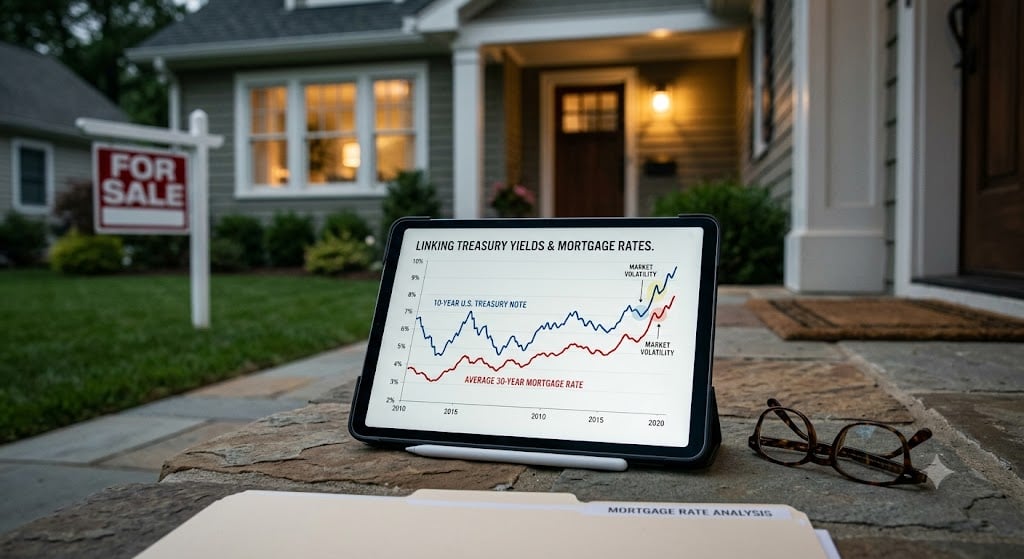
What mortgage rates actually track is the yield on the 10-year Treasury. Think of that yield as what investors demand to lend the government money for a decade. When they're worried about inflation, or when there's simply more borrowing to fund than there is appetite to fund it, they demand more. Mortgage-backed securities compete for the same investor dollars, so mortgage rates move with it.
Which is why you'll sometimes see the Fed hold steady, or even cut, while mortgage rates go up the same week. It isn't a glitch. They're not the same market.
The spread nobody explains
Mortgage rates don't sit right on top of the 10-year. They run above it, and that gap moves on its own.
Historically the spread has run somewhere between 1.5 and 2 points. Through 2023 and 2024 it widened to around 3, which is why mortgages felt punishing even when Treasury yields were merely elevated.
Right now it's back near 1.9. That's worth knowing, because it means mortgage rates have risen less than Treasury yields have over this stretch, and it's most of the reason today's rates aren't worse than they are.
Where things stand
The 10-year Treasury closed at 4.65% on Monday, after touching about 4.71% last week, its highest level since January 2025.
On the mortgage side, Freddie Mac's most recent weekly survey put the 30-year fixed average at 6.58%. Daily trackers have run higher, with Mortgage News Daily showing 6.77% last week, the highest in about a year. Rates are up roughly 80 basis points from where they bottomed in February.
The Fed meets Tuesday and Wednesday this week. Worth watching, but remember the point above: whatever they announce affects short-term rates directly and your mortgage only indirectly.
What's pushing it
Inflation that hasn't come back down. The war that began in late February constricted oil supply, and higher energy costs fed through to shipping, food, and effectively everything else. Inflation has been running in the mid-3s against a 2% target. Bond investors respond by demanding more yield to compensate for it.
A lot of borrowing chasing the same money. Federal deficits are large and the issuance to fund them is heavy. On top of that, corporate borrowing has been substantial, much of it funding data centers and infrastructure. More borrowers competing for the same pool of capital pushes the price of that capital up.
Uncertainty about where policy goes next. Investors aren't sure whether the next move is a hold, a cut, or a hike if inflation reaccelerates. That uncertainty carries a premium of its own, independent of what the Fed actually does.
Worth noting this isn't only a U.S. story. Long-dated yields have been climbing across developed markets. When that's happening everywhere at once, it's a global repricing of long-term debt rather than something specific to American housing.
What to actually do about it
I'm not going to tell you where rates are headed. Nobody knows, the forecasts published in January are reliably wrong by June, and any lender who tells you with confidence that rates will drop by spring is guessing.
What you can control:
Understand your lock before you need it. Know the length, the cost, whether a float-down is available, and what an extension costs per day. That last number is the one people get surprised by when escrow runs long.
Price out a buydown properly. Points reduce your rate, and whether that's worth the cash depends entirely on how long you'll keep the loan. Ask for the breakeven month. If it's past your realistic hold period, it isn't worth it no matter how good the lower payment looks.
Consider whether a fixed thirty is the right product. If you're confident you'll move or refinance inside a defined window, an ARM or a shorter fixed term may price better. That's a real trade-off with real risk, not a free lunch, but it deserves a conversation instead of an automatic default.
Don't wait for a number. People set a target rate in their head and sit out the market until it arrives. Sometimes it shows up. Sometimes prices in their neighborhood rise by more than the rate savings would have been worth. Whether it's the right time to buy depends far more on your situation, how long you'll stay, and what the payment does to your budget than on where the 10-year closed today.
The honest summary
Rates are near the top of their recent range, and the pressure is coming mostly from inflation that hasn't resolved and from the sheer volume of borrowing in the market. Both can turn quickly, in either direction, and the people who claim to know which way are not being straight with you.
If you want to talk through what these numbers mean for a specific purchase or refinance, we'll run it with you and tell you if the answer is to wait.
Call 800-913-2169.