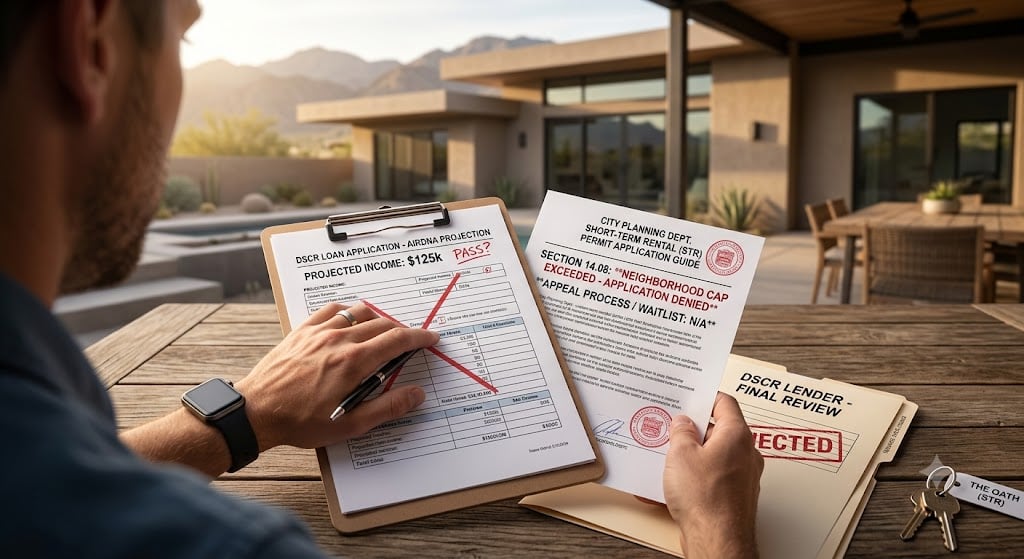
Most investors buying vacation rentals right now are using DSCR loans, and for good reason. You qualify on the property's income instead of your tax returns, which matters when you already own a few properties and your Schedule E is doing you no favors.
But there's a gap that trips people up constantly. The rent number you're underwriting to and the rent number the city will legally let you earn are often not the same number.
We see this play out a few times a year. A buyer finds a place in a market like Palm Springs or Nashville, pulls an AirDNA report showing strong nightly rates, gets pre-approved, and goes into escrow feeling good about it. Then the appraisal comes back with a Form 1007 built on long-term rents instead of nightly ones. The DSCR drops below 1.0. Now the loan needs another $80K down or it doesn't close, and it's day 19 of a 30-day escrow with earnest money already hard.
None of that is the lender being difficult. It's what happens when nobody checks the zoning before the file hits underwriting.
Where the projections and the rules come apart
Cities have gotten a lot more specific about short-term rentals over the past few years. The rules mostly fall into a handful of buckets:
- Permit caps. A fixed number of licenses citywide or by neighborhood, usually with a waitlist attached.
- Owner-occupancy requirements. You have to live there, which kills a pure investment play outright.
- Density limits. No more than a set percentage of homes per block or census tract.
- Night caps. A ceiling on how many nights a year you're allowed to rent.
- Hosted-only rules. You have to be on site during the stay.
Any one of these changes what an underwriter is allowed to count. They also change often. A market that penciled last spring may not pencil now, and the listing description is not going to tell you that.
What the underwriter actually needs to see
Underwriters don't reject short-term rental income because they doubt the market. They reject it when there's nothing in the file proving the income is legal.
If the property has a permit that transfers, or the market has no cap and the zoning plainly allows non-owner-occupied STRs, most lenders will use the short-term rent schedule. If any piece of that is unresolved, the appraiser falls back to standard 12-month market rent. No permit in hand will do it. So will a waitlist, or an owner-occupancy rule still sitting on the books.
That fallback is the whole problem. A property grossing $95,000 a year on nightly stays might only support $3,200 a month on a long-term lease. Run that against your PITIA and the coverage ratio you were counting on is gone.
Most DSCR programs want to see at least 1.0, and pricing improves as you move toward 1.25. Below 1.0, you're putting down more, buying the rate down, or restructuring the deal.
Three ways to structure around it
1. Buy where the permit is clean and transferable.
Simplest path, and worth saying out loud: some markets are effectively closed to new investor STRs right now, and that's fine. Plenty aren't. When the permit situation is clear, you get full DSCR treatment on the short-term rent schedule and none of the workarounds below matter.
2. Use a second home loan instead.
If you want to use the property personally anyway, this is often the better deal. Down payments start around 10%, and rates price better than DSCR. The tradeoffs are real. You have to occupy it part of the year, and you can't turn it over to a full-time management agreement. But you can rent it when you're not there. That's usually enough to carry the holding costs while you sit on a permit waitlist.
3. Underwrite it as a medium-term rental.
Thirty-day minimum stays sidestep most STR ordinances entirely, since most cities define "short-term" as anything under 30 days. Your tenants become travel nurses, insurance placements, corporate relocations, remote workers between leases. You give up peak nightly rates, but you get a rent number the underwriter can document with an actual lease, and in most of these markets it still beats a standard 12-month tenant by a wide margin.
Which one fits depends less on the property than on what you're trying to do with it. Someone scaling a portfolio across four states is solving a different problem than someone who wants a place in the desert their family actually uses.
Do this before you write the offer
Call the city or county planning department. Not the listing agent, not the seller. The planning department. Ask three questions:
- Is there a permit cap, and is it currently full?
- If there's a waitlist, how long is it right now?
- Does an existing permit transfer with the sale?
Then bring those answers to your lender before your earnest money goes hard. Fifteen minutes on the front end is worth more than any amount of scrambling at day 22.
Have us look at it first
At Convoy Home Loans, we review the zoning and the loan structure together, because pulling those apart is how deals die late. If you're targeting a specific market and want to know whether the numbers survive underwriting before you're committed, that's a short phone call.
Call us at 800-913-2169.